Course Features
Price
Study Method
Online | Self-paced
Course Format
Reading Material - PDF, article
Duration
11 hours, 5 minutes
Qualification
No formal qualification
Certificate
At completion
Additional info
Coming soon
- Share
Overview
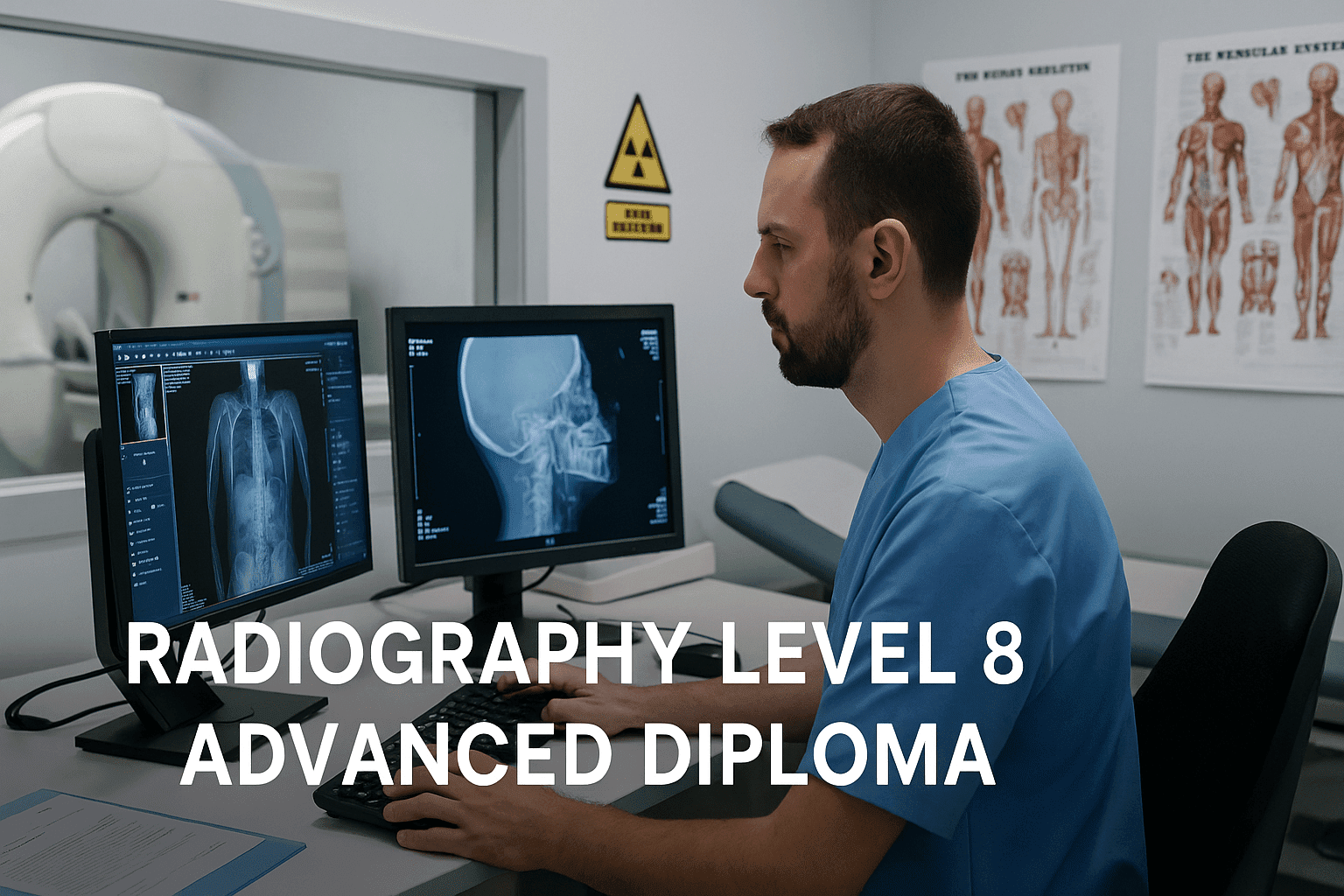
Radiography Advanced Diploma training at Level 8 provides an in-depth and highly specialised route for professionals seeking to expand their clinical expertise, refine their diagnostic accuracy, and build advanced leadership capability within UK radiology departments. This programme is designed to meet the demands of modern medical imaging, where radiographers must navigate rapidly evolving technologies, heightened safety standards, and increasing responsibilities in image interpretation and patient care.
Learners will develop a sophisticated understanding of medical imaging modalities, including CT, MRI, ultrasound, nuclear medicine, and hybrid systems, enabling them to work confidently across diverse clinical environments. The course also reinforces essential knowledge in radiation physics, dose optimisation, digital image processing, and equipment quality assurance—skills required to ensure safe, effective, and evidence-based practice in accordance with UK regulatory frameworks such as IR(ME)R.
A strong emphasis is placed on clinical judgement, critical thinking, and advanced image evaluation techniques. Learners strengthen their ability to detect abnormalities, identify trauma patterns, troubleshoot artefacts, and contribute meaningfully to multidisciplinary discussions. This advanced skill set is supported by modules in anatomy, pathology, and systematic interpretation, ensuring graduates can approach complex cases with precision and clarity.
The programme also prepares radiographers for leadership roles by exploring departmental management, workflow optimisation, communication strategies, clinical governance, and research methods. Through the development of a final project, learners gain experience in academic inquiry, data analysis, and evidence-based practice, further enhancing their professional credibility.
Delivered online with flexible study options, this diploma is suitable for working professionals who require a high-level qualification without disrupting their clinical responsibilities. At the end of the course, learners will receive a free course completion certificate, with the option to purchase premium certificates and official transcripts. All students benefit from our 5-star rated support team, available 24/7 through email, ensuring continuous guidance throughout their studies.
Who is this course for?
Radiography Advanced Diploma training at Level 8 provides an in-depth and highly specialised route for professionals seeking to expand their clinical expertise, refine their diagnostic accuracy, and build advanced leadership capability within UK radiology departments. This programme is designed to meet the demands of modern medical imaging, where radiographers must navigate rapidly evolving technologies, heightened safety standards, and increasing responsibilities in image interpretation and patient care.
Learners will develop a sophisticated understanding of medical imaging modalities, including CT, MRI, ultrasound, nuclear medicine, and hybrid systems, enabling them to work confidently across diverse clinical environments. The course also reinforces essential knowledge in radiation physics, dose optimisation, digital image processing, and equipment quality assurance—skills required to ensure safe, effective, and evidence-based practice in accordance with UK regulatory frameworks such as IR(ME)R.
A strong emphasis is placed on clinical judgement, critical thinking, and advanced image evaluation techniques. Learners strengthen their ability to detect abnormalities, identify trauma patterns, troubleshoot artefacts, and contribute meaningfully to multidisciplinary discussions. This advanced skill set is supported by modules in anatomy, pathology, and systematic interpretation, ensuring graduates can approach complex cases with precision and clarity.
The programme also prepares radiographers for leadership roles by exploring departmental management, workflow optimisation, communication strategies, clinical governance, and research methods. Through the development of a final project, learners gain experience in academic inquiry, data analysis, and evidence-based practice, further enhancing their professional credibility.
Delivered online with flexible study options, this diploma is suitable for working professionals who require a high-level qualification without disrupting their clinical responsibilities. At the end of the course, learners will receive a free course completion certificate, with the option to purchase premium certificates and official transcripts. All students benefit from our 5-star rated support team, available 24/7 through email, ensuring continuous guidance throughout their studies.
Requirements
Radiography Advanced Diploma training at Level 8 provides an in-depth and highly specialised route for professionals seeking to expand their clinical expertise, refine their diagnostic accuracy, and build advanced leadership capability within UK radiology departments. This programme is designed to meet the demands of modern medical imaging, where radiographers must navigate rapidly evolving technologies, heightened safety standards, and increasing responsibilities in image interpretation and patient care.
Learners will develop a sophisticated understanding of medical imaging modalities, including CT, MRI, ultrasound, nuclear medicine, and hybrid systems, enabling them to work confidently across diverse clinical environments. The course also reinforces essential knowledge in radiation physics, dose optimisation, digital image processing, and equipment quality assurance—skills required to ensure safe, effective, and evidence-based practice in accordance with UK regulatory frameworks such as IR(ME)R.
A strong emphasis is placed on clinical judgement, critical thinking, and advanced image evaluation techniques. Learners strengthen their ability to detect abnormalities, identify trauma patterns, troubleshoot artefacts, and contribute meaningfully to multidisciplinary discussions. This advanced skill set is supported by modules in anatomy, pathology, and systematic interpretation, ensuring graduates can approach complex cases with precision and clarity.
The programme also prepares radiographers for leadership roles by exploring departmental management, workflow optimisation, communication strategies, clinical governance, and research methods. Through the development of a final project, learners gain experience in academic inquiry, data analysis, and evidence-based practice, further enhancing their professional credibility.
Delivered online with flexible study options, this diploma is suitable for working professionals who require a high-level qualification without disrupting their clinical responsibilities. At the end of the course, learners will receive a free course completion certificate, with the option to purchase premium certificates and official transcripts. All students benefit from our 5-star rated support team, available 24/7 through email, ensuring continuous guidance throughout their studies.
Career path
Radiography Advanced Diploma training at Level 8 provides an in-depth and highly specialised route for professionals seeking to expand their clinical expertise, refine their diagnostic accuracy, and build advanced leadership capability within UK radiology departments. This programme is designed to meet the demands of modern medical imaging, where radiographers must navigate rapidly evolving technologies, heightened safety standards, and increasing responsibilities in image interpretation and patient care.
Learners will develop a sophisticated understanding of medical imaging modalities, including CT, MRI, ultrasound, nuclear medicine, and hybrid systems, enabling them to work confidently across diverse clinical environments. The course also reinforces essential knowledge in radiation physics, dose optimisation, digital image processing, and equipment quality assurance—skills required to ensure safe, effective, and evidence-based practice in accordance with UK regulatory frameworks such as IR(ME)R.
A strong emphasis is placed on clinical judgement, critical thinking, and advanced image evaluation techniques. Learners strengthen their ability to detect abnormalities, identify trauma patterns, troubleshoot artefacts, and contribute meaningfully to multidisciplinary discussions. This advanced skill set is supported by modules in anatomy, pathology, and systematic interpretation, ensuring graduates can approach complex cases with precision and clarity.
The programme also prepares radiographers for leadership roles by exploring departmental management, workflow optimisation, communication strategies, clinical governance, and research methods. Through the development of a final project, learners gain experience in academic inquiry, data analysis, and evidence-based practice, further enhancing their professional credibility.
Delivered online with flexible study options, this diploma is suitable for working professionals who require a high-level qualification without disrupting their clinical responsibilities. At the end of the course, learners will receive a free course completion certificate, with the option to purchase premium certificates and official transcripts. All students benefit from our 5-star rated support team, available 24/7 through email, ensuring continuous guidance throughout their studies.
-
- Introduction to Radiography and the UK Healthcare Context 00:10:00
- Role of the Radiographer within the NHS and Private Sector 00:10:00
- Medical Imaging Modalities: An Overview 00:10:00
- Radiographic Terminology, Anatomy Planes & Body Orientation 00:10:00
- Ethical, Legal, and Professional Standards in UK Radiography 00:10:00
-
- Fundamentals of Radiation Physics 00:10:00
- X-Ray Production and Interaction with Matter 00:10:00
- Radiation Units, Measurements & UK Dose Limits 00:10:00
- Radiation Protection: ALARA, PPE & Controlled Areas 00:10:00
- Quality Assurance in Radiation Safety (IR(ME)R Framework) 00:10:00
- X-Ray Machine Components & Digital Imaging Technology 00:10:00
- CR vs DR Systems: Comparison, Workflow & Image Quality 00:10:00
- Grid Systems, Beam Restriction & Exposure Factors 00:10:00
- Image Processing, Post-Processing & PACS 00:10:00
- Common Equipment Faults & Troubleshooting 00:10:00
- Computed Tomography (CT): Principles, Procedures & Safety 00:10:00
- Magnetic Resonance Imaging (MRI): Physics & Applications 00:10:00
- Ultrasound Imaging: Indications & Limitations 00:10:00
- Nuclear Medicine & PET Scans 00:10:00
- Hybrid Imaging Techniques in UK Hospitals 00:10:00
- Systematic Image Review Approaches (Search Patterns) 00:10:00
- Recognising Normal vs Abnormal Structures 00:10:00
- Detecting Fractures, Dislocations & Degenerative Changes 00:10:00
- Identifying Chest & Abdominal Abnormalities 00:10:00
- Image Artefacts: Causes, Types & Prevention 00:10:00
- Role of Radiographers in A&E, Major Trauma & Resuscitation 00:10:00
- Radiographic Protocols for Trauma Imaging 00:10:00
- Spinal Injuries & Immobilisation Procedures 00:10:00
- Polytrauma: Whole-Body CT Principles 00:10:00
- Rapid Image Interpretation & Communication During Emergencies 00:10:00
- Leadership Styles in Healthcare 00:10:00
- Managing Workflows, Staff & Radiology Department Operations 00:10:00
- Clinical Governance, Audit & Service Improvement 00:10:00
- Communication, Reporting & Interprofessional Collaboration 00:10:00
- Career Development Pathways in UK Radiography 00:10:00
- Exam of Radiography Level 8 Advanced Diploma 00:50:00

No Reviews found for this course.
Is this certificate recognized?
Yes, our premium certificate and transcript are widely recognized and accepted by embassies worldwide, particularly by the UK embassy. This adds credibility to your qualification and enhances its value for professional and academic purposes.
I am a beginner. Is this course suitable for me?
Yes, this course is designed for learners of all levels, including beginners. The content is structured to provide step-by-step guidance, ensuring that even those with no prior experience can follow along and gain valuable knowledge.
I am a professional. Is this course suitable for me?
Yes, professionals will also benefit from this course. It covers advanced concepts, practical applications, and industry insights that can help enhance existing skills and knowledge. Whether you are looking to refine your expertise or expand your qualifications, this course provides valuable learning.
Does this course have an expiry date?
No, you have lifetime access to the course. Once enrolled, you can revisit the materials at any time as long as the course remains available. Additionally, we regularly update our content to ensure it stays relevant and up to date.
How do I claim my free certificate?
I trust you’re in good health. Your free certificate can be located in the Achievement section. The option to purchase a CPD certificate is available but entirely optional, and you may choose to skip it. Please be aware that it’s crucial to click the “Complete” button to ensure the certificate is generated, as this process is entirely automated.
Does this course have assessments and assignments?
Yes, the course includes both assessments and assignments. Your final marks will be determined by a combination of 20% from assignments and 80% from assessments. These evaluations are designed to test your understanding and ensure you have grasped the key concepts effectively.
Is this course accredited?
We are a recognized course provider with CPD, UKRLP, and AOHT membership. The logos of these accreditation bodies will be featured on your premium certificate and transcript, ensuring credibility and professional recognition.
Will I receive a certificate upon completion?
Yes, you will receive a free digital certificate automatically once you complete the course. If you would like a premium CPD-accredited certificate, either in digital or physical format, you can upgrade for a small fee.
Course Features
Price
Study Method
Online | Self-paced
Course Format
Reading Material - PDF, article
Duration
11 hours, 5 minutes
Qualification
No formal qualification
Certificate
At completion
Additional info
Coming soon
- Share

Science-Based Bodyweight Training: Build Muscle and Lose Fat Anywhere
Course Line237£490.00Original price was: £490.00.£14.99Current price is: £14.99.IT Trainer Level 3 Advanced Diploma
Course Line238£490.00Original price was: £490.00.£14.99Current price is: £14.99.Mental Health First Aid
Course Line240£490.00Original price was: £490.00.£14.99Current price is: £14.99.


Related Courses
Holistic Health Coach Certification: Nutrition, Fitness & Lifestyle Coaching
£490.00Original price was: £490.00.£14.99Current price is: £14.99.237Life Coaching Certification: Core Skills, Models & Client Success
£490.00Original price was: £490.00.£14.99Current price is: £14.99.237Inpatient Coding Masterclass: DRG & PCS Complete Training
£490.00Original price was: £490.00.£14.99Current price is: £14.99.237




Related Courses
Holistic Health Coach Certification: Nutrition, Fitness & Lifestyle Coaching
£490.00Original price was: £490.00.£14.99Current price is: £14.99.237Life Coaching Certification: Core Skills, Models & Client Success
£490.00Original price was: £490.00.£14.99Current price is: £14.99.237Inpatient Coding Masterclass: DRG & PCS Complete Training
£490.00Original price was: £490.00.£14.99Current price is: £14.99.237