Course Features
Price
Study Method
Online | Self-paced
Course Format
Reading Material - PDF, article
Duration
6 hours, 5 minutes
Qualification
No formal qualification
Certificate
At completion
Additional info
Coming soon
- Share
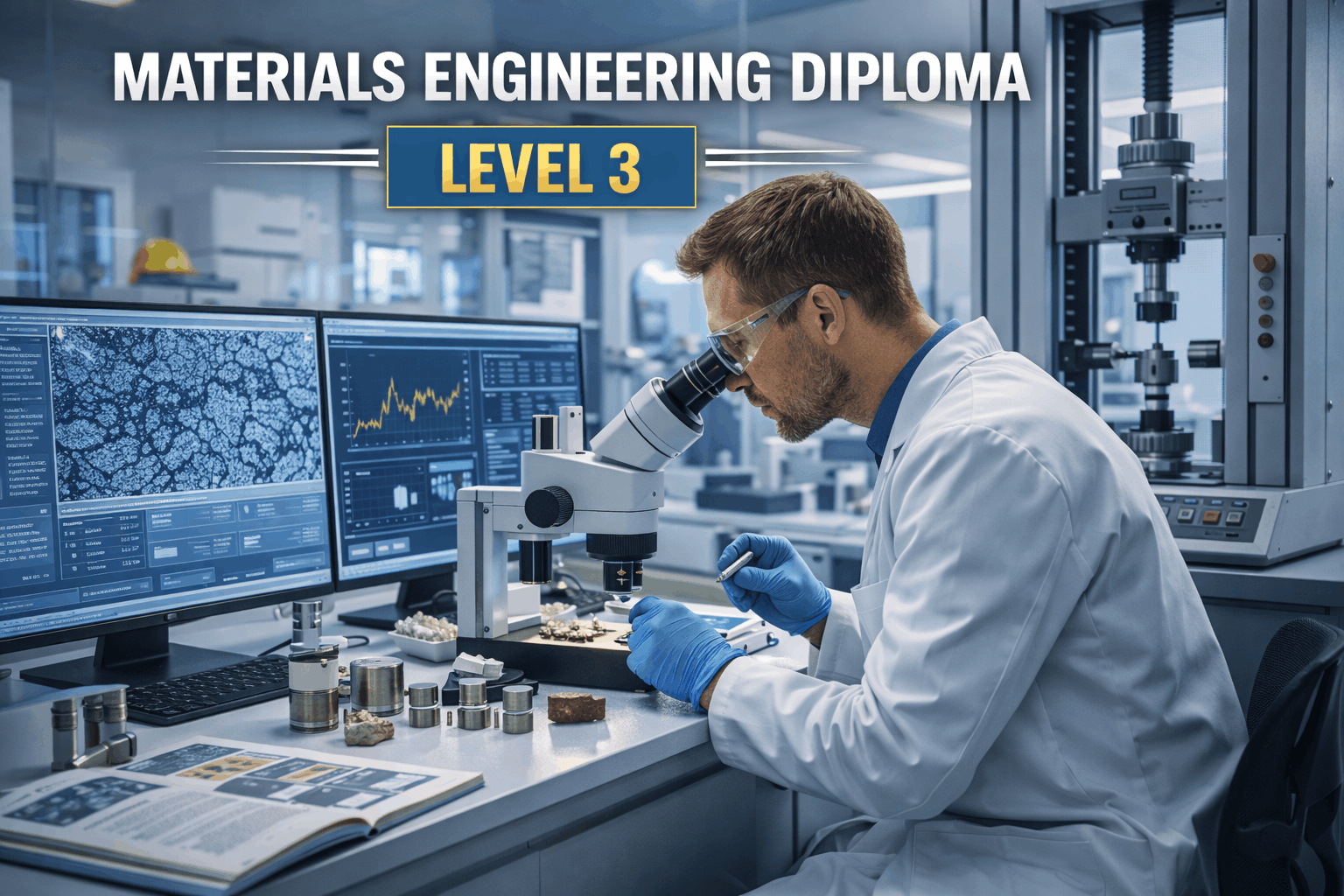
Overview
Materials Engineering Diploma is a Level 3 advanced programme designed for learners who want to understand how materials are selected, tested, and used in modern engineering and manufacturing. This course provides a strong foundation in the science and practical application of metals, polymers, ceramics, and composite materials used across a wide range of industries.
Throughout the programme, you will explore how materials are structured at the atomic and microscopic level and how this structure affects strength, flexibility, durability, and performance. You will learn how to classify materials, measure their properties, and understand why certain materials are chosen for specific engineering applications. Testing methods such as mechanical, thermal, electrical, and magnetic analysis help you see how materials behave under real working conditions.
A key focus of the Materials Engineering Diploma is material processing. You will learn how metals are cast and formed, how polymers and composites are manufactured, and how ceramics and glass are produced for technical uses. This gives you a clear picture of how raw materials become finished components used in products such as vehicles, aircraft, electronics, and medical devices.
The programme also introduces sustainability and environmental responsibility. You will explore life-cycle assessment, eco-friendly materials, and green alternatives that reduce environmental impact while maintaining performance. This ensures you are prepared to work in industries that value efficiency, innovation, and sustainability.
Future-focused topics such as nanomaterials, smart materials, and additive manufacturing are included, helping you understand how materials engineering is evolving. These emerging technologies are shaping the next generation of products and engineering solutions.
By completing the Materials Engineering Diploma, you will gain practical and theoretical knowledge that supports entry into engineering, manufacturing, or technical study. At the end of the course, learners will receive a free course completion certificate, with multiple premium certificate and transcript options also available for purchase if they wish. Students also benefit from 5-star rated support available 24/7 through email.
Graduates can move into roles such as materials technician, quality control assistant, laboratory technician, or manufacturing support engineer. The course also provides a solid foundation for further study in materials science, mechanical engineering, aerospace engineering, or industrial technology.
Who is this course for?
Materials Engineering Diploma is a Level 3 advanced programme designed for learners who want to understand how materials are selected, tested, and used in modern engineering and manufacturing. This course provides a strong foundation in the science and practical application of metals, polymers, ceramics, and composite materials used across a wide range of industries.
Throughout the programme, you will explore how materials are structured at the atomic and microscopic level and how this structure affects strength, flexibility, durability, and performance. You will learn how to classify materials, measure their properties, and understand why certain materials are chosen for specific engineering applications. Testing methods such as mechanical, thermal, electrical, and magnetic analysis help you see how materials behave under real working conditions.
A key focus of the Materials Engineering Diploma is material processing. You will learn how metals are cast and formed, how polymers and composites are manufactured, and how ceramics and glass are produced for technical uses. This gives you a clear picture of how raw materials become finished components used in products such as vehicles, aircraft, electronics, and medical devices.
The programme also introduces sustainability and environmental responsibility. You will explore life-cycle assessment, eco-friendly materials, and green alternatives that reduce environmental impact while maintaining performance. This ensures you are prepared to work in industries that value efficiency, innovation, and sustainability.
Future-focused topics such as nanomaterials, smart materials, and additive manufacturing are included, helping you understand how materials engineering is evolving. These emerging technologies are shaping the next generation of products and engineering solutions.
By completing the Materials Engineering Diploma, you will gain practical and theoretical knowledge that supports entry into engineering, manufacturing, or technical study. At the end of the course, learners will receive a free course completion certificate, with multiple premium certificate and transcript options also available for purchase if they wish. Students also benefit from 5-star rated support available 24/7 through email.
Graduates can move into roles such as materials technician, quality control assistant, laboratory technician, or manufacturing support engineer. The course also provides a solid foundation for further study in materials science, mechanical engineering, aerospace engineering, or industrial technology.
Requirements
Materials Engineering Diploma is a Level 3 advanced programme designed for learners who want to understand how materials are selected, tested, and used in modern engineering and manufacturing. This course provides a strong foundation in the science and practical application of metals, polymers, ceramics, and composite materials used across a wide range of industries.
Throughout the programme, you will explore how materials are structured at the atomic and microscopic level and how this structure affects strength, flexibility, durability, and performance. You will learn how to classify materials, measure their properties, and understand why certain materials are chosen for specific engineering applications. Testing methods such as mechanical, thermal, electrical, and magnetic analysis help you see how materials behave under real working conditions.
A key focus of the Materials Engineering Diploma is material processing. You will learn how metals are cast and formed, how polymers and composites are manufactured, and how ceramics and glass are produced for technical uses. This gives you a clear picture of how raw materials become finished components used in products such as vehicles, aircraft, electronics, and medical devices.
The programme also introduces sustainability and environmental responsibility. You will explore life-cycle assessment, eco-friendly materials, and green alternatives that reduce environmental impact while maintaining performance. This ensures you are prepared to work in industries that value efficiency, innovation, and sustainability.
Future-focused topics such as nanomaterials, smart materials, and additive manufacturing are included, helping you understand how materials engineering is evolving. These emerging technologies are shaping the next generation of products and engineering solutions.
By completing the Materials Engineering Diploma, you will gain practical and theoretical knowledge that supports entry into engineering, manufacturing, or technical study. At the end of the course, learners will receive a free course completion certificate, with multiple premium certificate and transcript options also available for purchase if they wish. Students also benefit from 5-star rated support available 24/7 through email.
Graduates can move into roles such as materials technician, quality control assistant, laboratory technician, or manufacturing support engineer. The course also provides a solid foundation for further study in materials science, mechanical engineering, aerospace engineering, or industrial technology.
Career path
Materials Engineering Diploma is a Level 3 advanced programme designed for learners who want to understand how materials are selected, tested, and used in modern engineering and manufacturing. This course provides a strong foundation in the science and practical application of metals, polymers, ceramics, and composite materials used across a wide range of industries.
Throughout the programme, you will explore how materials are structured at the atomic and microscopic level and how this structure affects strength, flexibility, durability, and performance. You will learn how to classify materials, measure their properties, and understand why certain materials are chosen for specific engineering applications. Testing methods such as mechanical, thermal, electrical, and magnetic analysis help you see how materials behave under real working conditions.
A key focus of the Materials Engineering Diploma is material processing. You will learn how metals are cast and formed, how polymers and composites are manufactured, and how ceramics and glass are produced for technical uses. This gives you a clear picture of how raw materials become finished components used in products such as vehicles, aircraft, electronics, and medical devices.
The programme also introduces sustainability and environmental responsibility. You will explore life-cycle assessment, eco-friendly materials, and green alternatives that reduce environmental impact while maintaining performance. This ensures you are prepared to work in industries that value efficiency, innovation, and sustainability.
Future-focused topics such as nanomaterials, smart materials, and additive manufacturing are included, helping you understand how materials engineering is evolving. These emerging technologies are shaping the next generation of products and engineering solutions.
By completing the Materials Engineering Diploma, you will gain practical and theoretical knowledge that supports entry into engineering, manufacturing, or technical study. At the end of the course, learners will receive a free course completion certificate, with multiple premium certificate and transcript options also available for purchase if they wish. Students also benefit from 5-star rated support available 24/7 through email.
Graduates can move into roles such as materials technician, quality control assistant, laboratory technician, or manufacturing support engineer. The course also provides a solid foundation for further study in materials science, mechanical engineering, aerospace engineering, or industrial technology.
-
- Overview of Materials Engineering 00:10:00
- Classification of Materials 00:10:00
- Basic Properties of Materials 00:10:00
-
- Atomic Structure and Bonding 00:10:00
- Crystalline and Amorphous Structures 00:10:00
- Microstructure of Materials 00:10:00
- Mechanical Testing of Materials 00:10:00
- Thermal Properties Testing 00:10:00
- Electrical and Magnetic Properties 00:10:00
- Introduction to Polymers 00:10:00
- Composites Materials 00:10:00
- Properties and Testing of Polymers and Composites 00:10:00
- Metal Forming and Casting 00:10:00
- Polymer and Composite Processing 00:10:00
- Ceramic and Glass Processing 00:10:00
- Materials in Aerospace Engineering 00:10:00
- Materials in Automotive Engineering 00:10:00
- Materials in Biomedical Engineering 00:10:00
- Exam of Materials Engineering Level 3 Advanced Diploma 00:50:00

No Reviews found for this course.
Is this certificate recognized?
Yes, our premium certificate and transcript are widely recognized and accepted by embassies worldwide, particularly by the UK embassy. This adds credibility to your qualification and enhances its value for professional and academic purposes.
I am a beginner. Is this course suitable for me?
Yes, this course is designed for learners of all levels, including beginners. The content is structured to provide step-by-step guidance, ensuring that even those with no prior experience can follow along and gain valuable knowledge.
I am a professional. Is this course suitable for me?
Yes, professionals will also benefit from this course. It covers advanced concepts, practical applications, and industry insights that can help enhance existing skills and knowledge. Whether you are looking to refine your expertise or expand your qualifications, this course provides valuable learning.
Does this course have an expiry date?
No, you have lifetime access to the course. Once enrolled, you can revisit the materials at any time as long as the course remains available. Additionally, we regularly update our content to ensure it stays relevant and up to date.
How do I claim my free certificate?
I trust you’re in good health. Your free certificate can be located in the Achievement section. The option to purchase a CPD certificate is available but entirely optional, and you may choose to skip it. Please be aware that it’s crucial to click the “Complete” button to ensure the certificate is generated, as this process is entirely automated.
Does this course have assessments and assignments?
Yes, the course includes both assessments and assignments. Your final marks will be determined by a combination of 20% from assignments and 80% from assessments. These evaluations are designed to test your understanding and ensure you have grasped the key concepts effectively.
Is this course accredited?
We are a recognized course provider with CPD, UKRLP, and AOHT membership. The logos of these accreditation bodies will be featured on your premium certificate and transcript, ensuring credibility and professional recognition.
Will I receive a certificate upon completion?
Yes, you will receive a free digital certificate automatically once you complete the course. If you would like a premium CPD-accredited certificate, either in digital or physical format, you can upgrade for a small fee.
Course Features
Price
Study Method
Online | Self-paced
Course Format
Reading Material - PDF, article
Duration
6 hours, 5 minutes
Qualification
No formal qualification
Certificate
At completion
Additional info
Coming soon
- Share

Architecture Level 8 Advanced Diploma
Course Line243£490.00Original price was: £490.00.£14.99Current price is: £14.99.English Grammar Level 3 Advanced Diploma
Course Line248£490.00Original price was: £490.00.£14.99Current price is: £14.99.Inventory Management: Techniques for Efficient Stock Control and Optimization
Course Line242£490.00Original price was: £490.00.£14.99Current price is: £14.99.



Related Courses
Engineering Mathematics Level 5 Advanced Diploma
£490.00Original price was: £490.00.£14.99Current price is: £14.99.237Civil Engineering Building Construction Fundamentals: Site, Codes & Quantity Skills
£490.00Original price was: £490.00.£14.99Current price is: £14.99.237CNC Milling Machine Programming Masterclass: From Basics to Advanced G-Code
£490.00Original price was: £490.00.£14.99Current price is: £14.99.237



Related Courses
Engineering Mathematics Level 5 Advanced Diploma
£490.00Original price was: £490.00.£14.99Current price is: £14.99.237Civil Engineering Building Construction Fundamentals: Site, Codes & Quantity Skills
£490.00Original price was: £490.00.£14.99Current price is: £14.99.237CNC Milling Machine Programming Masterclass: From Basics to Advanced G-Code
£490.00Original price was: £490.00.£14.99Current price is: £14.99.237